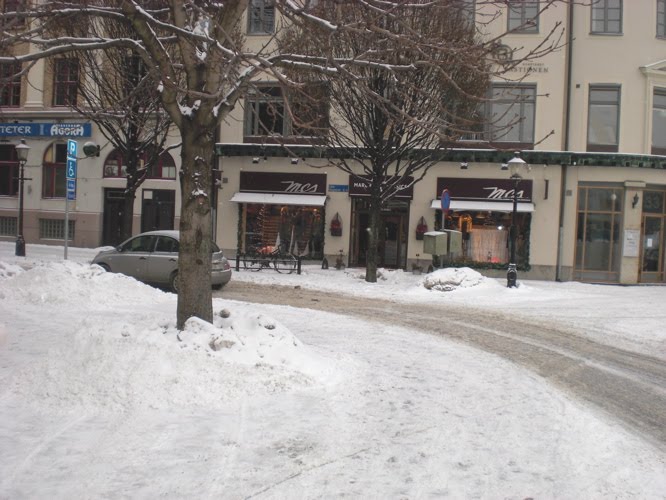
Wednesday, February 9, 2011

Back in Falköping

I’ve been back in Falköping about a week since wrapping up my two-month contract at JG Communication in Stockholm.

It was an absolute whirlwind eight weeks.

My parents visited for the holidays.


A week later, my brother got his first taste of Sweden (and several other European countries).


Juggling their visits and maintaining a longish-distance relationship while learning about the complex field of telecommunications on the fly was a challenge, but I wouldn’t trade the experience for anything. I’m very lucky to be continuing my work with JG on a freelance basis.

It’s really nice to be home again after 8,000 SEK ($1,250 USD) of train travel between Falköping and Stockholm, at least every weekend and some weeks even more frequently.


The trip can be as short as 2 hours, 20 minutes or as long as 3 hours, 42 minutes, depending on the speed/type of train.

There are exactly 341 kilometers of rail between Falköping and Stockholm, which is about 212 miles. To put my commute in perspective for a Californian, the following drives are each between 210 and 220 miles: Reno to San Francisco on I-80, Eureka to Santa Rosa on US-101 and Sacramento to Visalia (45 minutes southeast of Fresno) and Fresno to Los Angeles, both on CA-99.

The cycle quickly became quite routine, though.


It’s not feasible to travel that distance daily, but I was fortunate enough to be able to spend weeknights in Stockholm, one of the toughest places to find rental living in the entire world, while spending the other three in Falköping.

I rented a room from Amanda’s aunt during the weeks and I owe Annika and Amanda’s awesome cousins Tind and William a huge thanks for putting up with me. I couldn’t have accepted my first job in Sweden without them, and although the flexibility of freelancing from home for a while will be nice, I’m looking forward to what the future holds for me here on the employment front.

Tuesday, January 11, 2011

A Typical Swede

What is a Swede?

As much as I hate to stereotype anyone, Swedes can often be some of the easiest people in the world to make generalizations about.

The text below was rumored to be discovered in a computer lab in Umeå, a city in northern Sweden.

Not everyone fits a single mold, and keep in mind that this is written to be funny, but a striking number of Swedes I encounter on a daily basis exhibit many of these traits...

Enjoy.

A Typical Swede

A Swede is tall, blonde, blue-eyed, and wears a wooly hat in the winter. By nature he is shy, reserved, serious, industrous, and finds it hard to laugh at himself. He is also a creature of habit and every morning gets up at 5.30 to give himself enough time to read the morning newspaper before going to work. Since work does not usually start until 8 o’clock, this can only imply that a Swede is also a slow reader.

Apart from himself, his chief interests are money, his job, his home, ice-hockey, and his family (in that order). He also loves animals – especially dogs – and spends hours cycling through the town dragging a huge and ferocious German Shepherd behind him on a leash.

A Swede is usually punctual, honest, reliable, clean, has his own teeth, and is law-abiding. Evidence of the latter is particularly noticeable at pedestrian crossings. No matter what the weather is like, a Swede would rather get soaked to the skin than cross an empty street when a red light is showing. Similarly, he always wears a seat belt, never drinks and drives, always has a television licence, usually hands in his tax-return on time, invariably has a plastic bag in his pocket when he walks his dog, and never has a bath after 10 o’clock.

A Swede is also very cautious and rarely does anything on impulse (except perhaps sneeze). To him, all decisions are a matter of life and death. Take a simple matter like buying cheese, for example. A Swede may try at least ten different sorts of cheeses before finally deciding to buy twenty grammes of Brie. It is the same sense of caution that prevents him from plunging into marriage straight away. Instead, he lives with a woman first, has one or two children, then – if all seems well – asks her to marry him.

With reference to marriage, a Swede is quite unlike most European men. Anything a housewife can do, he can do better – from cooking to sewing on buttons. In fact, everything in the home (apart from breast-feeding) is shared.

A Swede also likes to think he is well informed and spends hours finding out all he can about such things as nuclear power, the Third World, pollution, South Africa, the sexual habits of the centipede, etc. while at the same time paying little attention to unimportant matters - such as the name of his neighbor or whether certain types of beer should be banned or not.

Most Swedes as fanatics when it comes to keeping fit and regularly spend their weekends running through the nearest forest or cycling for hours in the cellar on a bicycle fixed to the floor. With his health in mind, he has also given up smoking, sugar, drinking coffee in the evenings, going to bed after 10 o’clock, and mixing with strangers.

But perhaps the greatest thing about a Swede is his sense of equality – of everyone being the same as everyone else. To help this, most Swedes have the same surnames – Svensson, Nilsson, or Persson – earn the same amount of money after tax, have the same taste in furniture, dress alike, think alike, drive a Volvo, and go to Majorca or Kreta in the summer.

A Swede also refuses to admit that he is prejudiced in any way. To him, all foreigners are just the same as Swedes and, although he doesn’t actually have any Jugoslavian, Greek, Turkish, Polish, Italian, Finnish or Czechoslovakian friends, he is certain there is very little difference between them and Swedes – apart from their names, their customs, the way they grow vegetables in the kitchen, the fact that they carry knives, rob banks, live on social security, pinch their jobs, breed like rabbits, beat their wives, and speak Swedish like someone with a gobstopper in his mouth.

Finally, a Swede loves the sun, hates queuing, gets a kick out of being first on the bus, detests winter, enjoys sex, can’t stand gypsies, believes what the National Social Board of Health and Welfare tells him, doesn’t believe in God, worships Ingemar Stenmark, only gets drunk when he drinks, is patriotic (wears Swedish flag underwear), visits the off-licence twice a week, visits his parents at Christmas, goes to English classes, and, inevitably, is deeply offended by an article such as this.

Saturday, January 1, 2011

Reflecting on 2010

I rang in 2011 last night the same way I kicked off 2010: happy, healthy, employed and celebrating with friends in the bitter cold of a Swedish winter. As we said goodbye to one year and welcomed another, it really sank in how monumental 2010 was.

It was a year of firsts, from experiences (helicopter flights and bottle service) to travel (Scotland, Italy and Las Vegas twice).


Some firsts weren’t so positive. 2010 was the first year I didn’t even snowboard once in December. I was also forced to sell a car for the first time. Fortunately, I’ll see it around Arcata when I visit since I sold it to a friend. Unfortunately, it won’t be MRWINTR because I had to release the personalized plate and according to the DMV website it has already been registered to a new vehicle. It was the best car I’ve ever driven and I could really have used it over here in all this snow.


Early in 2010, I made the decision to leave my California life behind to spend the next few years in Europe. Much of the winter and early spring were spent filling out residence permit paperwork between a near-record number of snowboarding trips.

A couple months later I finally graduated from college. Cliché as it may sound, it really was a long road and sometimes it’s hard to imagine I had just finished my first semester in the dorms only five years ago.


Professionally, 2010 was quite an adventure, too.

One minute I was sharing a Sugar Bowl chairlift with US Olympian Daron Rahlves.


A few months later, I was unemployed for the first time since age 12. After three unforgettable years at the Auburn Journal it was time to move on. I’ll never take for granted the opportunities I had or the people I worked with in the foothill communities.

After five months of not knowing what to do with myself, I finally landed short-term employment as a consultant at JG Communication, writing internal and external articles primarily for Ericsson. There are only four weeks left on my contract and I’ll soon be unemployed again, but I’ve learned some pretty incredible stuff on the marketing side of journalism in a very short time.

2010 was a year of great concerts, including Wiz Khalifa (for the second year in a row), Three 6 Mafia, Jason Derulo and Chamillionaire.


I saw some pretty good baseball at Dodger Stadium, then lost a little faith in the sport when the Giants defied all odds to win the World Series.

I also ate two of the best meals I can remember. The first was a four-course menu at Capitol Garage with pairings from Lost Coast Brewery during Sacramento Beer Week. Looking at this menu again is making my mouth water.


Amanda and I also had a spectacular dinner in Las Vegas at Fleur de Lys in Mandalay Bay.


I made some strides in the kitchen myself this year, perfecting the ingredient ratios for my sun-dried tomato gorgonzola mashed potatoes.


By the time I moved to Sweden in August, I was also cooking healthier and more gourmet than ever before.


2011 is already looking like it’ll be another great year. I’ll check two new countries off my list in the first month alone. Hopefully I find some stability in my professional life while I continue to enjoy this beautiful country I call home.

Sunday, December 19, 2010

Sobriety Checkpoints

We were walking down a remote side street in Göteborg this afternoon, near the Avenyn, when we came across a small cluster of cops standing in the road.

Here’s an unsuspecting motorist turning down the street.


We watched for a while and it became clear they were waiting to stop the few cars that happened to travel down that isolated street.

It was a typical Swedish sobriety checkpoint. I’d heard about them many times but hadn’t encountered one in my first four months here.


Such DUI stops are astonishingly common here. So common that Swedish police executed more than 2.5 MILLION breath tests in 2009.

I just can’t wrap my head around that number, for a few reasons. Since I’m killing time in the hotel while we wait to hear if my parents’ flight is going to get off the ground from Brussels tonight, I decided to reference some tables and charts on the Statistics Sweden website to help me explain how mind-boggling that figure is.

As of last New Year’s Eve, Sweden’s population was 9,340,682. That’s 2.5 million breath tests in a country with fewer than 10 million people.

Then you’ve got to remember than the driving age is 18 and there are about 2 million kids too young to be on the roads. Very few people over age 80 are driving around either, so let’s also subtract that half-a-million.

The number is even more astounding when you consider that an estimated 85 percent of the population lives in urban areas, and the other 1.5 to 2 million people live in the large cities like Stockholm and Göteborg. Very few of those people even own cars due to the efficient public transportation systems.

If you accept those calculations, that probably means 1 in every 2 drivers were stopped and breathalyzed in 2009. Obviously some didn’t encounter a single checkpoint and others were tested multiple times last year but on average, that’s 1 in 2.

So how is that possible? How can Swedish police legally issue breath tests to that many people?

Swedes scoff at the constitutional protections California’s drivers are afforded. In the Golden State, landmark Supreme Court cases have created major burdens for police to conduct legal DUI checkpoints. These requirements include:
  • The checkpoint should be located on a major thoroughfare (streets with a high concentration of DUI arrests or accidents)
  • Checkpoints must be advertised in media outlets at least one week in advance
  • Checkpoints must be identified by signs or lights so they are obvious to approaching vehicles
  • There MUST be a marked route to circumvent a checkpoint, and drivers must commit a moving violation or show obvious signs of impairment to be pulled over for taking such a route around a checkpoint
  • For drivers who are stopped at a checkpoint, police must establish probable cause that they are intoxicated in order to conduct breath or other field sobriety tests
Those are some high hurdles for California’s cops. Swedish law enforcement officers face none of those restrictions.

The thing that struck me most about the checkpoint in Göteborg today wasn’t that it was unadvertised, unmarked or that it was located on a side street with little traffic. It wasn’t even that every driver was tested. It was that police were conducting it at 2 p.m. On a Sunday. Not a Friday or Saturday night or a holiday weekend.


I asked my girlfriend why and was shocked to hear the police were likely targeting drivers who may have imbibed too much last night. They may have made the right decision not to get behind the wheel last night, but if they still had even minor traces of alcohol in their system some 12 hours later, the police were there to arrest them.

Sweden lowered the blood-alcohol limit from .05 to .02 in 1990 — four times lower than California and most other states. I read on a lawyer’s blog recently that his local police department approximates that a 180-pound man can drink six beers or five mixed drinks in two hours before reaching the .08 threshold.

Pretty incredible, then, to think that a BAL of .10 or higher in Sweden is deemed “aggravated drunk driving” and first-time offenders are usually sentenced to two years in prison. That’s only a drink or two more than what a driver can legally consume in California. No wonder the Golden State has more than twice as many alcohol-involved fatalities as Sweden.

Observing the checkpoint this afternoon really got me thinking. We’re so concerned with the government violating our constitutional rights in California, but is guaranteeing these extreme protections coming at the cost of avoidable DUI deaths?

I don’t completely agree with Sweden’s drunk driving prevention measures, but there’s got to be a middle ground between this and the way things are enforced in California that can still save lives, right?

Monday, November 29, 2010

Winter's Here

The Swedish Meteorological and Hydrological Institute, the country’s lead weather agency, has a pretty tangible rule for the arrival of winter. When the median day temperature stays in the minus, the season Swedes detest is here.

We’re enjoying our first clear day in over a week. It’s been nonstop snow since last weekend and although the snowfalls have generally been light, the accumulations have added up.


It started with a few dustings that caused us to sweep our front walkway for the first time.


Pretty soon, our front yard had a nice blanket.


The city doesn’t bother making any serious effort to plow most streets in town, including the one in front of our apartment, because vehicles are required by law to use winter tires after November 1 each year and Swedish drivers are more than used to these road conditions. Just not usually in November.


The same scene looked like this less than 48 hours later.


A couple more meters and the view from our living room will start to become obstructed.


We've stopped trying to keep pace with our white walkway.


Last winter was one of epic proportions for the entire country. Temperature and snowfall records were set from the north to the south, and people are freaking out because the first major snow this winter came almost three weeks earlier than last.

“Experts” — and why anyone would want the responsibility that comes with that title where the weather is so unpredictable is beyond me — have predicted a colder, wetter winter than last year. I scoffed at that until I read that the temperature in northern Lapland one night last week dropped to the lowest November reading measured in Sweden in 15 years: negative 36 Celsius. That’s –32.8 Fahrenheit, almost 65 degrees below freezing.

Even though our region is far less extreme than Lapland by comparison, the forecast for the next three days here says highs of –8 Celsius and lows of –14 Celsius.

Saturday, November 20, 2010

'System' Failure?

It’s a lazy Saturday afternoon and you’re lounging on your couch. You get a call from a friend inviting you to a spur-of-the-moment dinner party. Great, you think. You didn’t have anything fun to do and you start looking forward to an evening of good food and great company.

Your friend phoned at 2:15, so you’ve got plenty of time to get ready. Except that you live in Sweden, and in a situation that would dictate you to bring a nice bottle of wine you’re probably going to show up at your friend’s house empty-handed. How rude.

See, for more than a half-century all alcohol in Sweden stronger than 3.5 percent has been sold only at restaurants and bars and through the government-run liquor monopoly called Systembolaget (“The System Company”).


In California, you can buy any alcohol you want in virtually any grocery store. You can buy it between 6 a.m. and 2 a.m. The beer is chilled in-store and is always cold when you buy it. Alcohol is inexpensive and can be even cheaper if you buy in larger quantities like 12-packs or cases.

Sweden couldn’t be much more restrictive without banning booze altogether.

The strongest beer sold in grocery stores is labeled Class II and called folköl, “people’s beer.” An even weaker Class I beer can be of maximum 2.25 percent strength and is called lättöl (“light beer”).

Class III beer, starköl ("strong beer"), is everything stronger than 3.5 percent and is only sold at Systembolaget. Wines and spirits, which are obviously all stronger than 3.5 percent, are only sold at The System.

Buying alcohol at Systembolaget is a much different experience than shopping for drinks in a store back home. No beer is refrigerated. All items are sold as individual cans or bottles and there is no discount for buying a case of beer. No brand can be favored over any other, so there are never sales or specials.

The hours are absurdly limited. Systembolaget locations are closed on Sundays and holidays. They’re only open from 10 a.m. to 2 p.m. on Saturdays and close at 6 p.m. on Fridays. The latest they’re open all week is 7 p.m. on Thursdays.


Alcohol is taxed on strength rather than price, with different tables corresponding to beer, wine and liquor. It’s all heavily taxed, though.

The cheapest can of beer (the same size as a 12-ounce can of Coors Light, for instance) costs between 9 and 10 Swedish kronor after tax. At the current exchange rate, that’s between $1.31 and $1.46 USD per can.

Hard liquor is ridiculously expensive. To buy a bottle of Jägermeister and a bottle of Bacardi Apple rum (which are also only 700 mL bottles rather than the 750 mL fifths sold in the States) would cost 494 SEK, or about $72 USD.


If you found both on sale at a grocery chain in California, it’d probably run about $20-$25 for the same two bottles.

The Swedish government maintains that keeping the monopoly in place has kept alcohol out of minors’ hands and discouraged binge drinking among adults. You must be at least 20 years old to buy alcohol at Systembolaget, which runs national television ads urging its patrons to imbibe responsibly.

As much as I bag on The System as an annoying, outdated concept, I have found one silver lining. Since the government imports wine from across Europe and the rest of the world in such large quantities, those savings are passed on to Swedes in spite of the high taxes.

The System set a new record in 2009 by selling more than 170 million liters of wine, and the four-liter boxes introduced in the late 1990s are largely to thank. The boxed wine isn’t the Franzia crap sold in the States, either. Quality stuff at a reasonable price.


Systembolaget causes a lot of frustration, especially for new expatriates. I don’t think it works the way the government would like everyone to believe it does, but there’s no alternative. You get used to it. You memorize the hours and you learn to plan ahead. You join the masses who tote the signature purple bags around town on Friday afternoons, when going to The System is literally a social event.


I’ve learned my lesson. Always stash away a couple extra bottles of wine when you’re in Sweden. You never know when you might need them.

Thursday, November 18, 2010

Three Months Later

My connecting flight from Munich touched down in Sweden three months ago to the hour. Several weeks after arriving, Scandinavia slowly started to feel like my new home.

The first month really seemed like a vacation, primarily because it was the same duration as my first visit here last winter and also because Sweden is a very festive country in late summer. Swedes have to party themselves out before darkness shrouds the land all winter.

Eventually, I remembered that I actually live here now. I registered with the Swedish Tax Board and was assigned a personnummer (like a U.S. Social Security number, only it’s used much more frequently and for many more things in Sweden). I opened a bank account, bought a cell phone and registered for a government-funded Swedish language course. Then I switched my renter’s insurance from Sacramento to Falköping. It finally felt official.

Amanda and I didn’t expect everything to go according to our original plan, but we’ve had to adapt to a few more changes than we might have guessed.

When I left California, we were all set to lease an apartment in Jönköping, the city where she goes to school. I figured I’d have a good job by now and speak fluent Swedish.

Not so much.

We spent the first 10 weeks in this house on Amanda’s mom’s farm, 15 kilometers outside of her hometown, Falköping.


We moved into our own apartment in the heart of town last week. Great location and an old-school fireplace complemented by some antique furniture. It’s pretty cozy. We love it.


We decided to get a place here for two major reasons. First, as you’ll see on the map below, Falköping is more centrally located to both Jönköping (47 minutes by train to the south) and the second-largest city in Sweden, Göteborg (1 hour, 7 minutes by train to the west).


In addition, virtually all our friends and Amanda’s extended family reside in the Falköping area, and although I’ve been swiftly rejected for a growing list of English teaching and communication jobs, living close enough to commute daily to Göteborg — a huge city with a metropolitan population approaching 1 million — can’t hurt my employment prospects.

My Swedish has improved considerably after only three weeks of classes, but I’m still not where I’d like to be. I start a more advanced course next week so hopefully my language skills will increase at an even quicker rate.

After three months here, everyone I meet still questions my move to one of coldest, gloomiest places on the planet. I can count on two hands the people here who haven’t called me crazy to my face for leaving California for southern Sweden.

In their defense, movies and T.V. shows have tricked them into thinking every mile of the Golden State looks like a San Diego or Los Angeles beach. Nobody here believes there’s snowboarding in California.

I’ve learned to laugh at all the dropped jaws and headshakes. I don’t regret my decision to move here at all. Sure, I miss California — from the people to the prices — but I chose to make Sweden my new home and I’m still loving every minute of it.