Saturday, November 20, 2010

'System' Failure?

It’s a lazy Saturday afternoon and you’re lounging on your couch. You get a call from a friend inviting you to a spur-of-the-moment dinner party. Great, you think. You didn’t have anything fun to do and you start looking forward to an evening of good food and great company.

Your friend phoned at 2:15, so you’ve got plenty of time to get ready. Except that you live in Sweden, and in a situation that would dictate you to bring a nice bottle of wine you’re probably going to show up at your friend’s house empty-handed. How rude.

See, for more than a half-century all alcohol in Sweden stronger than 3.5 percent has been sold only at restaurants and bars and through the government-run liquor monopoly called Systembolaget (“The System Company”).


In California, you can buy any alcohol you want in virtually any grocery store. You can buy it between 6 a.m. and 2 a.m. The beer is chilled in-store and is always cold when you buy it. Alcohol is inexpensive and can be even cheaper if you buy in larger quantities like 12-packs or cases.

Sweden couldn’t be much more restrictive without banning booze altogether.

The strongest beer sold in grocery stores is labeled Class II and called folköl, “people’s beer.” An even weaker Class I beer can be of maximum 2.25 percent strength and is called lättöl (“light beer”).

Class III beer, starköl ("strong beer"), is everything stronger than 3.5 percent and is only sold at Systembolaget. Wines and spirits, which are obviously all stronger than 3.5 percent, are only sold at The System.

Buying alcohol at Systembolaget is a much different experience than shopping for drinks in a store back home. No beer is refrigerated. All items are sold as individual cans or bottles and there is no discount for buying a case of beer. No brand can be favored over any other, so there are never sales or specials.

The hours are absurdly limited. Systembolaget locations are closed on Sundays and holidays. They’re only open from 10 a.m. to 2 p.m. on Saturdays and close at 6 p.m. on Fridays. The latest they’re open all week is 7 p.m. on Thursdays.


Alcohol is taxed on strength rather than price, with different tables corresponding to beer, wine and liquor. It’s all heavily taxed, though.

The cheapest can of beer (the same size as a 12-ounce can of Coors Light, for instance) costs between 9 and 10 Swedish kronor after tax. At the current exchange rate, that’s between $1.31 and $1.46 USD per can.

Hard liquor is ridiculously expensive. To buy a bottle of Jägermeister and a bottle of Bacardi Apple rum (which are also only 700 mL bottles rather than the 750 mL fifths sold in the States) would cost 494 SEK, or about $72 USD.


If you found both on sale at a grocery chain in California, it’d probably run about $20-$25 for the same two bottles.

The Swedish government maintains that keeping the monopoly in place has kept alcohol out of minors’ hands and discouraged binge drinking among adults. You must be at least 20 years old to buy alcohol at Systembolaget, which runs national television ads urging its patrons to imbibe responsibly.

As much as I bag on The System as an annoying, outdated concept, I have found one silver lining. Since the government imports wine from across Europe and the rest of the world in such large quantities, those savings are passed on to Swedes in spite of the high taxes.

The System set a new record in 2009 by selling more than 170 million liters of wine, and the four-liter boxes introduced in the late 1990s are largely to thank. The boxed wine isn’t the Franzia crap sold in the States, either. Quality stuff at a reasonable price.


Systembolaget causes a lot of frustration, especially for new expatriates. I don’t think it works the way the government would like everyone to believe it does, but there’s no alternative. You get used to it. You memorize the hours and you learn to plan ahead. You join the masses who tote the signature purple bags around town on Friday afternoons, when going to The System is literally a social event.


I’ve learned my lesson. Always stash away a couple extra bottles of wine when you’re in Sweden. You never know when you might need them.

Thursday, November 18, 2010

Three Months Later

My connecting flight from Munich touched down in Sweden three months ago to the hour. Several weeks after arriving, Scandinavia slowly started to feel like my new home.

The first month really seemed like a vacation, primarily because it was the same duration as my first visit here last winter and also because Sweden is a very festive country in late summer. Swedes have to party themselves out before darkness shrouds the land all winter.

Eventually, I remembered that I actually live here now. I registered with the Swedish Tax Board and was assigned a personnummer (like a U.S. Social Security number, only it’s used much more frequently and for many more things in Sweden). I opened a bank account, bought a cell phone and registered for a government-funded Swedish language course. Then I switched my renter’s insurance from Sacramento to Falköping. It finally felt official.

Amanda and I didn’t expect everything to go according to our original plan, but we’ve had to adapt to a few more changes than we might have guessed.

When I left California, we were all set to lease an apartment in Jönköping, the city where she goes to school. I figured I’d have a good job by now and speak fluent Swedish.

Not so much.

We spent the first 10 weeks in this house on Amanda’s mom’s farm, 15 kilometers outside of her hometown, Falköping.


We moved into our own apartment in the heart of town last week. Great location and an old-school fireplace complemented by some antique furniture. It’s pretty cozy. We love it.


We decided to get a place here for two major reasons. First, as you’ll see on the map below, Falköping is more centrally located to both Jönköping (47 minutes by train to the south) and the second-largest city in Sweden, Göteborg (1 hour, 7 minutes by train to the west).


In addition, virtually all our friends and Amanda’s extended family reside in the Falköping area, and although I’ve been swiftly rejected for a growing list of English teaching and communication jobs, living close enough to commute daily to Göteborg — a huge city with a metropolitan population approaching 1 million — can’t hurt my employment prospects.

My Swedish has improved considerably after only three weeks of classes, but I’m still not where I’d like to be. I start a more advanced course next week so hopefully my language skills will increase at an even quicker rate.

After three months here, everyone I meet still questions my move to one of coldest, gloomiest places on the planet. I can count on two hands the people here who haven’t called me crazy to my face for leaving California for southern Sweden.

In their defense, movies and T.V. shows have tricked them into thinking every mile of the Golden State looks like a San Diego or Los Angeles beach. Nobody here believes there’s snowboarding in California.

I’ve learned to laugh at all the dropped jaws and headshakes. I don’t regret my decision to move here at all. Sure, I miss California — from the people to the prices — but I chose to make Sweden my new home and I’m still loving every minute of it.

Sunday, October 24, 2010

Pets

It’s hard to believe it’s already been three weeks since Amanda’s dad had to put down his young Doberman, Zorro.


Zorro was barely five years old but had long suffered from a rare disease multiple veterinarians couldn’t diagnose. His toenails split and infection reached the pulp and bone. They never healed and he was eventually in so much pain he almost couldn’t walk.

It’s been a tough month for all of us without Zorro. He’s already very missed.


Pets are of utmost importance in Swedish society. Most people I know here practically make the average American pet owner look negligent.

People don’t go anywhere without their animals. If they must temporarily leave them behind at home, it’s never for more than a few hours.

Amanda watched this dog’s owner wrap it in a sweater in Göteborg while she went inside for minute to buy a pastry.


Pets in Sweden provide much more than just companionship and protection. In many ways, they’re treated more like human children than animals.

I’m surrounded by animals here. Since virtually all Amanda’s extended family on both mom’s and dad’s side live within what feels like a 20-kilometer radius, we usually see their pets at least a few times a week.

I’ve become more of a cat person over the last couple months. On her mom’s farm, they’ve got 12-year-old siblings Timon (named after the meerkat in the Lion King) and K.K., who both live in a barn. K.K.’s real name is Katten Katten (Cat Cat) from a Swedish television show on which all the animals were called by their double animal name.


The cats share a barn with a few sheep, while the rest of the sheep on the farm are pasture grazers.


Amanda’s dad has brothers Oscar, left, and Diesel. Oscar resembles K.K. a lot.


Also on dad’s side, Amanda’s aunt Pema has a pretty cool pug, Julius, left, and another dog, Chewy.


Pema often takes care of Grandma’s pug, Sara.


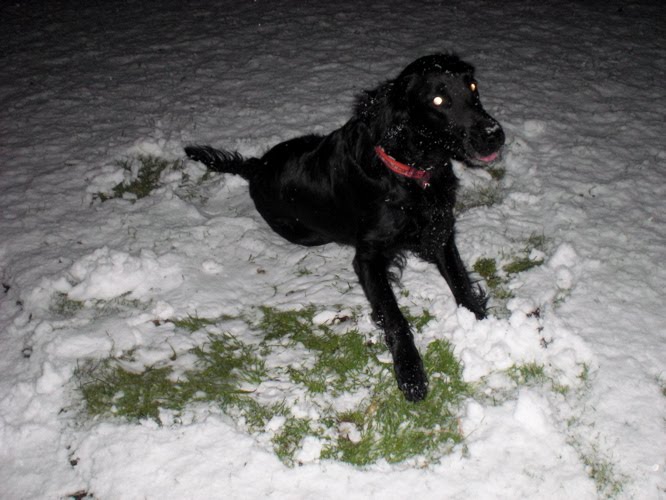
My favorite pet is Wilma, Amanda’s mom’s flatcoated retriever. I’ve never known an animal with so much personality. She’s 8, but acts eight months.

Wilma loved playing with Zorro. The big dogs chased Amanda’s sister’s Chihuahua, Sixten, on a regular basis.


Wilma does it all.

She hunts for mice.


She swims.


She’s an expert tracking dog, so hide and seek is a favorite game.


She loves her blankets.


And she’ll stop at nothing to get them back.


Even if it means leaping a meter off the ground to pull them out of a tree.


Wilma is also the only member of the family who loves snow more than me, day and night.


Friday, October 22, 2010

Winter's Almost Here

If there’s one thing about weather native Swedes learn at an early age, it’s how quickly fall can become winter.

I took this picture on Amanda’s mom’s farm last Thursday, Oct. 14.


Here’s the exact same part of the yard last night — one week later — when we received our first notable snowfall.


We had a dusting one night last weekend and I thought this early afternoon video I shot would be the extent of Thursday’s snow.


I was wrong, and it definitely won’t be the last time I underestimate the Swedish weather. As I finished doing the dishes around 9 p.m., I saw this out the window.


The snow gradually intensified and was still coming down at midnight. By morning, we had a nice blanket of about five centimeters (two inches). Not much, but pretty impressive for mid-October and only 228 meters (750 feet) above sea level.


Most of it had melted by midday today, and temperatures are expected to rise the next few nights while this precipitation hovers over the country.


But I know the snow and cold temperatures will soon return, and maybe even surpass the record-setting winter in Sweden last winter. Polish scientists are predicting Europe’s coldest winter in 1,000 years. I’m juiced, even if 99.99 percent of the people here dread the thought.

Wednesday, October 13, 2010

Christmas in October

After dealing with a serious dearth of shirts, pants and hoodies during my first two months in Sweden, I was reunited Wednesday with the rest of my threads and other important personal effects shipped by sea.

The whole process further supported my stereotype that shipping is one of the scummiest business operations on the planet. From my limited experiences, the receiving offices are usually in the sketchiest industrial parks, like the one in Göteborg, below, which Amanda also used to transport items when she first moved back home after three years in California.


The agents operating them are usually sleazy and unhelpful. Once they have your money, they stop responding to emails. Your shipment often gets to the port many days after its scheduled arrival and the agents are still slow to go pick it up. There are multiple customs and residency forms to fill out, some of which you’re told about only after repeatedly calling to check on the status of your shipment.

Seven weeks to the day, I’m just happy to see my clothes, snowboard and snow gear and digital SLR camera again. Opening the boxes felt remarkably like Christmas, since I even forgot about a few things I packed. I could have shipped much more volume for the approximately $400 USD minimum (half to the company in Oakland where I dropped it off and half to the company in Göteborg where I picked it up) but this was really all I needed since I packed very smart and took advantage of the rate being based on volume rather than weight, unlike most other companies out there.

It doesn’t look like much all boxed up, but the shipment weighed a combined 49 kilograms (108 pounds).


I’m singing the praises of vacuum bags, which enabled me to ship most of my wardrobe in only 4.5 cubic feet. These things hold about four times more clothing than it looks like.


Here’s what those two boxes look like unpacked. I was even more impressed after removing the clothes from each vacuum bag.


I hope to avoid dealings with any shipping companies for a long time. At least I’m ready to hit the slopes as soon as the snow starts falling and I’ll be making fewer trips to the laundry room from now on.

Sunday, October 3, 2010

Autumn

Autumn, or fall as it’s called in the United States, officially arrived about a week ago. Surprisingly, temperatures have remained mild — pleasant enough to bike the surrounding farmland without a jacket on a recent afternoon.


We had a few nights last week that dipped into the high 30s Fahrenheit but since then temperatures have hovered between 58 and 62 during the day and 45 and 49 overnight. Admittedly I’m in the minority, but I’m hoping Sweden sees its second straight record-setting winter with below-zero temperatures and meters of snowfall. Unfortunately, it feels like we’ve got a long way to go before everything is white again.

While we can’t wait to move into town — the current tenants will vacate the apartment we signed a lease for last week by November 15 — one perk of living out in the country is the evening sky. The sun will soon disappear for many weeks, so we’re savoring some pretty spectacular “late-summer” sunsets while they last.