Saturday, February 18, 2012

Monday, January 23, 2012
Falköping Alpin
I never realized how spoiled I was in Sacramento, a short 90-minute drive from major Tahoe resorts.
I mean, California snow is garbage compared to the “cold smoke” I rode on in Montana, but that’s not a fair comparison. Most Swedes don’t even believe I snowboarded in a state that movies portray as looking entirely like a beach. Point being, I was lucky I got to ride as often as I did during those five winters.
I’ve only hit the slopes twice in one-and-a-half winters in a country that movies portray as looking predominantly like the North Pole. How ironic is that?
Thing is, it has to be cold for snow. In California that means going to high elevations. In Sweden, we have our northern latitude to thank for low temperatures, even at low elevations.
The highest point, Kebnekaise in the far north, has a peak of 2,111 meters (a little under 7,000 feet). And there’s not even any commercial skiing around there. Several Tahoe resorts have a higher elevation than that — at their base.
We live in southern Sweden and most of the big resorts are many hours north. We’re fortunate to have a tiny mountain in our town (average elevation of just 230 meters, 750 feet). Most of the neighboring cities have nothing.

Falköping Alpin only has two runs I can really use, “Slalombacken” and ”Mittlöpan,” the longer of which is a very short 400 meters (a quarter-mile).

I had Slalombacken mostly to myself on Sunday after a decent storm Saturday night.

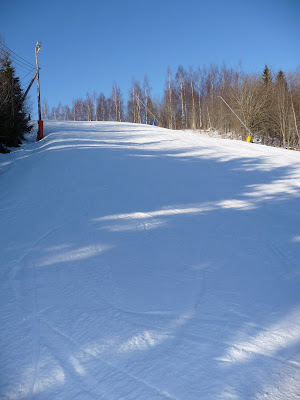
Here's a view looking up Slalombacken I shot on a bluebird day last winter.
To the far right is Mittlöpan on the same day, with a few medium kickers.

It's rather underwhelming and gets old fast, but beggars can’t be choosers and considering that I can walk there from our apartment in less than 20 minutes and a lift pass runs a little more than $20 USD, I can’t complain too much.

Sure, there are only rope tows, since chairlifts aren’t feasible for such short distances.

And it takes about 30 seconds to speed down the steepest run, but it’s something. And I don’t have to take an overnight train to get some action.
Though I do plan to make a trek to the north in the near future to experience the famed Åre resort pictures below.

I mean, California snow is garbage compared to the “cold smoke” I rode on in Montana, but that’s not a fair comparison. Most Swedes don’t even believe I snowboarded in a state that movies portray as looking entirely like a beach. Point being, I was lucky I got to ride as often as I did during those five winters.
I’ve only hit the slopes twice in one-and-a-half winters in a country that movies portray as looking predominantly like the North Pole. How ironic is that?
Thing is, it has to be cold for snow. In California that means going to high elevations. In Sweden, we have our northern latitude to thank for low temperatures, even at low elevations.
The highest point, Kebnekaise in the far north, has a peak of 2,111 meters (a little under 7,000 feet). And there’s not even any commercial skiing around there. Several Tahoe resorts have a higher elevation than that — at their base.
We live in southern Sweden and most of the big resorts are many hours north. We’re fortunate to have a tiny mountain in our town (average elevation of just 230 meters, 750 feet). Most of the neighboring cities have nothing.

Falköping Alpin only has two runs I can really use, “Slalombacken” and ”Mittlöpan,” the longer of which is a very short 400 meters (a quarter-mile).

I had Slalombacken mostly to myself on Sunday after a decent storm Saturday night.

Here's a view looking up Slalombacken I shot on a bluebird day last winter.

To the far right is Mittlöpan on the same day, with a few medium kickers.

It's rather underwhelming and gets old fast, but beggars can’t be choosers and considering that I can walk there from our apartment in less than 20 minutes and a lift pass runs a little more than $20 USD, I can’t complain too much.

Sure, there are only rope tows, since chairlifts aren’t feasible for such short distances.

And it takes about 30 seconds to speed down the steepest run, but it’s something. And I don’t have to take an overnight train to get some action.
Though I do plan to make a trek to the north in the near future to experience the famed Åre resort pictures below.

Monday, December 19, 2011
Darkness
There’s a crucial aspect of Sweden’s geography that I’m starting to realize very few people back in the States grasp.
Although, considering that on visits back more than two old acquaintances have asked, “How’s Switzerland?” maybe I’m expecting too much? I digress.
Sweden has extremely high northern latitude. Our town, which is in the southern third of the country, is virtually the same latitude as Juneau, Alaska.

Why does it matter? Well, aside from the obvious climate effects of 15 percent of your country actually lying north of the Arctic Circle, it means the solstices are very pronounced.
During the summer, we enjoy long days with early sunrises and sunlight into the late evening. That comes with the tradeoff of dark days in the winter months, of course.
And after the summer solstice in late June, that shift from light to dark happens more quickly than you might imagine. While commuting to Stockholm every day during the late summer and early fall, I snapped a quick photo from the platform every Thursday morning at 6 a.m. from August 18 through September 29. These photos show the week-by-week progression towards darkness over seven weeks:


And the days have been much darker than that the last couple of months leading up to the winter solstice this Thursday — the shortest, darkest day of the year. The good news is there will only be more and more light each day from here on out until Midsummer.
On Thursday, the projected sunrise in Sacramento is 7:21 a.m., with a sunset at 4:49 p.m.
Here in Falköping, the sun won’t rise until 8:52 a.m. and it will set at 3:17 p.m. That’s three fewer hours of light on the darkest day.
I guess I should just be thankful we don’t live further north, where polar twilight or polar night engulf parts of the largest Nordic countries for much of the winter. Some towns will be lucky to have a few hours of twilight reflecting off the snow during the worst four weeks of the year from early December to early January.
The sun won’t even rise Thursday in Kiruna, Sweden’s northernmost city, but apparently they have to put something on the weather websites, anyway.

So when you think the days feel short in the U.S. in late December, just remember that they could always be shorter.
Although, considering that on visits back more than two old acquaintances have asked, “How’s Switzerland?” maybe I’m expecting too much? I digress.
Sweden has extremely high northern latitude. Our town, which is in the southern third of the country, is virtually the same latitude as Juneau, Alaska.

Why does it matter? Well, aside from the obvious climate effects of 15 percent of your country actually lying north of the Arctic Circle, it means the solstices are very pronounced.
During the summer, we enjoy long days with early sunrises and sunlight into the late evening. That comes with the tradeoff of dark days in the winter months, of course.
And after the summer solstice in late June, that shift from light to dark happens more quickly than you might imagine. While commuting to Stockholm every day during the late summer and early fall, I snapped a quick photo from the platform every Thursday morning at 6 a.m. from August 18 through September 29. These photos show the week-by-week progression towards darkness over seven weeks:


And the days have been much darker than that the last couple of months leading up to the winter solstice this Thursday — the shortest, darkest day of the year. The good news is there will only be more and more light each day from here on out until Midsummer.
On Thursday, the projected sunrise in Sacramento is 7:21 a.m., with a sunset at 4:49 p.m.
Here in Falköping, the sun won’t rise until 8:52 a.m. and it will set at 3:17 p.m. That’s three fewer hours of light on the darkest day.
I guess I should just be thankful we don’t live further north, where polar twilight or polar night engulf parts of the largest Nordic countries for much of the winter. Some towns will be lucky to have a few hours of twilight reflecting off the snow during the worst four weeks of the year from early December to early January.
The sun won’t even rise Thursday in Kiruna, Sweden’s northernmost city, but apparently they have to put something on the weather websites, anyway.

So when you think the days feel short in the U.S. in late December, just remember that they could always be shorter.
Thursday, December 15, 2011
Lucia
Tuesday was St. Lucia’s Day in Sweden and other Nordic countries.
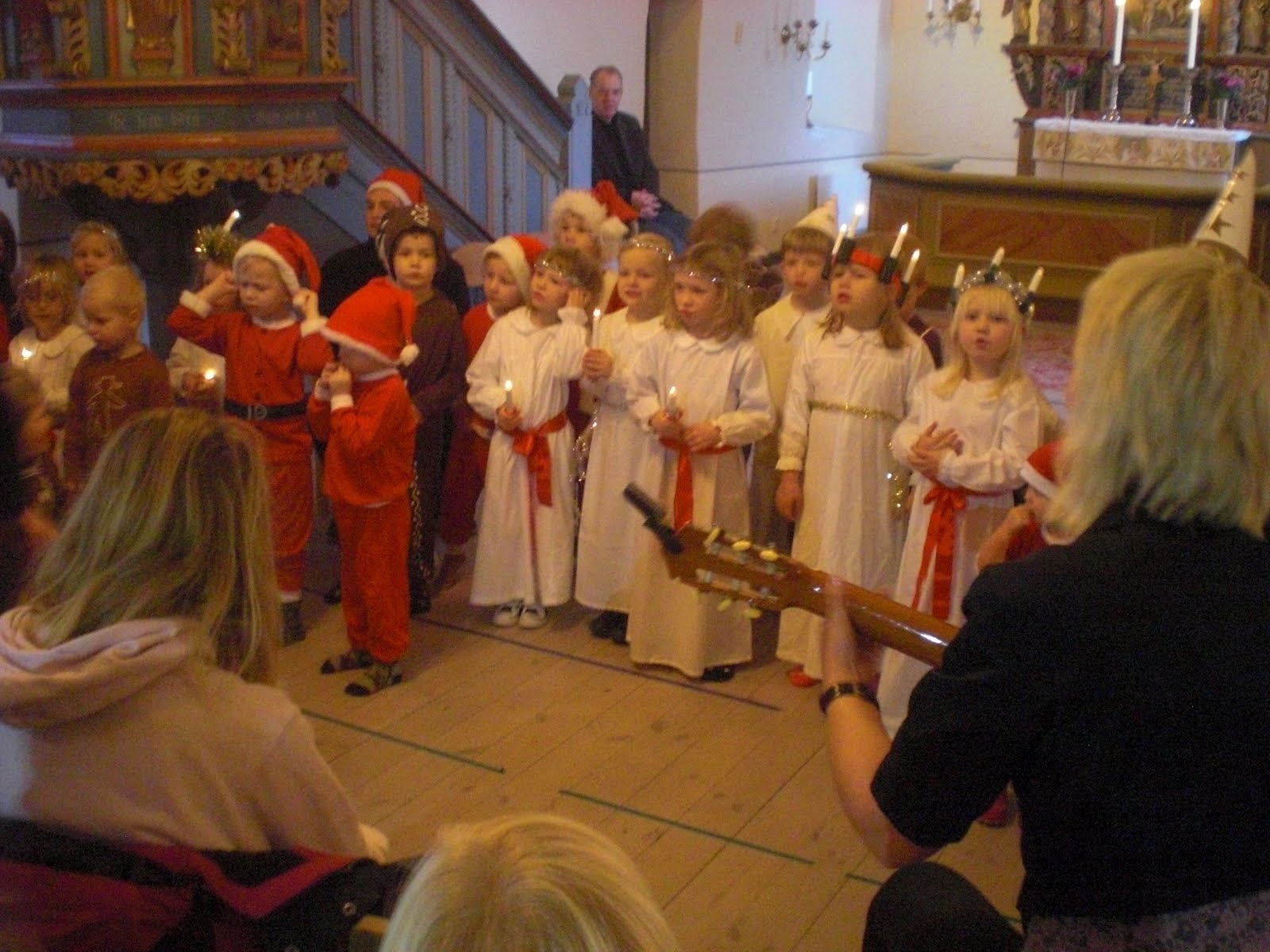
December 13 is the day to commemorate Lucia, a martyred Catholic saint. In a traditional Swedish celebration known as a luciatåg, a girl wearing a white dress and a crown of candles leads a procession of maidens.
Many processions also include star boys, and those performed by young children often feature gingerbread men and Santas as additional characters.
The celebrations revolve around singing. Sweden followed the Julian calendar until 1700, and December 13 was the shortest, darkest day of the year. The main song is about St. Lucia bringing light to the darkness.
People eat gingerbread and drink mulled wine, but my favorite food associated with the day is lussekatter, saffron buns that are eaten throughout Advent but particularly on this day.

Saffron, the world’s most expensive spice by weight, quickly became one of my favorite baking flavors when I moved here. I didn’t even really know what it was in the States.
Lucia is a winter tradition I hadn’t experienced yet, because I was working in Stockholm at this time last year and two years ago I hadn’t quite arrived for my first visit.
We spent the morning with a group of elementary school children from the school where Amanda’s mom works. They performed a procession in a church next to their school, about 20 minutes south of our town.

The parents loved every second of it.

December 13 is the day to commemorate Lucia, a martyred Catholic saint. In a traditional Swedish celebration known as a luciatåg, a girl wearing a white dress and a crown of candles leads a procession of maidens.
Many processions also include star boys, and those performed by young children often feature gingerbread men and Santas as additional characters.
The celebrations revolve around singing. Sweden followed the Julian calendar until 1700, and December 13 was the shortest, darkest day of the year. The main song is about St. Lucia bringing light to the darkness.
People eat gingerbread and drink mulled wine, but my favorite food associated with the day is lussekatter, saffron buns that are eaten throughout Advent but particularly on this day.

Saffron, the world’s most expensive spice by weight, quickly became one of my favorite baking flavors when I moved here. I didn’t even really know what it was in the States.
Lucia is a winter tradition I hadn’t experienced yet, because I was working in Stockholm at this time last year and two years ago I hadn’t quite arrived for my first visit.
We spent the morning with a group of elementary school children from the school where Amanda’s mom works. They performed a procession in a church next to their school, about 20 minutes south of our town.
The parents loved every second of it.

Tuesday, December 6, 2011
Swedish Pizza
It is inexplicable that I’ve lived here for almost 16 months without blogging about Swedish pizza.
It’s been a staple of our diet since the day I moved to Sweden. I’ve estimated I probably eat six pizzas per month, on average.
Swedish pizza — which isn’t actually Swedish at all, but I’ll get to that in a minute — is healthier than their American counterparts. The crust is thinner, and the cheese and toppings aren’t always loaded on as heavily.
Pizza is also arguably the best bang for your kronor when it comes to eating out in Sweden. You might not have guessed it, but McDonald’s, Burger King and the like are insanely expensive over here. A pizza can run anywhere from $9 USD to $13 USD, making it one of the cheapest dinner options around. Swedish pizza is never sold by the slice, and in most scenarios the only size — around 12 inches across, but remember, it’s also thin — is the perfect amount to be a “personal pizza.”
Italian immigrants who came to Sweden to work in the late 1960s and early 1970s brought pizza here with them. Today, virtually every Swedish pizzeria is owned and operated by immigrants from one of the many countries that border the Mediterranean Sea. We’ve discovered only one, near Amanda’s family’s summer house, that is run by Swedes.
The most popular Swedish pizza (by a longshot) is kebab pizza. In the Middle East, where kebab originates, it’s supposed to be lamb meat. Here, it’s some nasty blend of lamb (if you’re lucky) with beef, chicken, pork, turkey and even goat, fish or other seafood, roasted on a vertical spit. It really is just shaved “meat.” I wouldn’t touch it with a three-meter pole, but most Swedes love it.
Kebab pizzas are smothered in both a yogurty sauce and a hotter sauce. Most Swedish pizzas are topped with some type of sauce, typically Bernaise.
The first Swedish pizza I ate during my original visit was a Quattro Stagioni (“four seasons”) with ham, mushrooms, mussels and shrimp each covering one quarter of the pizza. It was probably my go-to choice for my first six months here.
My favorite pizza these days is the Africana, which usually includes chicken, bananas, peanuts, curry powder and sometimes even shrimp, often with a pineapple ring in the center.

There’s even a place in town that serves it with a liquid form of curry. Remember what I said about sauces?

Bananas aren’t even the “weirdest” topping to someone accustomed to American pizza. At the lone “Swedish pizzeria” we know this summer, Amanda’s friend Nathalie ordered a pizza with meat sauce and asparagus.

Amanda’s Napoli pizza of sundried tomatoes and mushrooms was also loaded with broccoli and spring mix.

No matter if you’re sitting down or taking it home, every pizza in Sweden is served with an included order of “pizza salad,” a sour but tasty combination of shredded raw cabbage, oil, vinegar and spices.

Some people eat it before and some enjoy it as a side dish. Others put it on their pizza. I didn’t like it in the beginning, but it quickly grew on me.
Many people ask me whether I prefer Swedish or American pizza, expecting to hear the latter. But there really are a lot of things I like about Swedish pizza.
There’s a joke that every town and city in Sweden, regardless of total population, has one pizzeria for every 1,000 residents. In our city of roughly 15,000, that’s probably spot-on. I’ll have to count someday.
Anyway, my point is that there’s something almost endearing about how imperfect each pizza is. Even the spelling of the pizzeria can have flaws.

Every Swedish pizzeria is unique — Pizza Hut is the only chain with any level of Nordic penetration — and you never know quite what you’re going to get.


But you can almost always bet it will be delicious.
It’s been a staple of our diet since the day I moved to Sweden. I’ve estimated I probably eat six pizzas per month, on average.
Swedish pizza — which isn’t actually Swedish at all, but I’ll get to that in a minute — is healthier than their American counterparts. The crust is thinner, and the cheese and toppings aren’t always loaded on as heavily.
Pizza is also arguably the best bang for your kronor when it comes to eating out in Sweden. You might not have guessed it, but McDonald’s, Burger King and the like are insanely expensive over here. A pizza can run anywhere from $9 USD to $13 USD, making it one of the cheapest dinner options around. Swedish pizza is never sold by the slice, and in most scenarios the only size — around 12 inches across, but remember, it’s also thin — is the perfect amount to be a “personal pizza.”
Italian immigrants who came to Sweden to work in the late 1960s and early 1970s brought pizza here with them. Today, virtually every Swedish pizzeria is owned and operated by immigrants from one of the many countries that border the Mediterranean Sea. We’ve discovered only one, near Amanda’s family’s summer house, that is run by Swedes.
The most popular Swedish pizza (by a longshot) is kebab pizza. In the Middle East, where kebab originates, it’s supposed to be lamb meat. Here, it’s some nasty blend of lamb (if you’re lucky) with beef, chicken, pork, turkey and even goat, fish or other seafood, roasted on a vertical spit. It really is just shaved “meat.” I wouldn’t touch it with a three-meter pole, but most Swedes love it.
Kebab pizzas are smothered in both a yogurty sauce and a hotter sauce. Most Swedish pizzas are topped with some type of sauce, typically Bernaise.
The first Swedish pizza I ate during my original visit was a Quattro Stagioni (“four seasons”) with ham, mushrooms, mussels and shrimp each covering one quarter of the pizza. It was probably my go-to choice for my first six months here.
My favorite pizza these days is the Africana, which usually includes chicken, bananas, peanuts, curry powder and sometimes even shrimp, often with a pineapple ring in the center.

There’s even a place in town that serves it with a liquid form of curry. Remember what I said about sauces?

Bananas aren’t even the “weirdest” topping to someone accustomed to American pizza. At the lone “Swedish pizzeria” we know this summer, Amanda’s friend Nathalie ordered a pizza with meat sauce and asparagus.

Amanda’s Napoli pizza of sundried tomatoes and mushrooms was also loaded with broccoli and spring mix.

No matter if you’re sitting down or taking it home, every pizza in Sweden is served with an included order of “pizza salad,” a sour but tasty combination of shredded raw cabbage, oil, vinegar and spices.

Some people eat it before and some enjoy it as a side dish. Others put it on their pizza. I didn’t like it in the beginning, but it quickly grew on me.
Many people ask me whether I prefer Swedish or American pizza, expecting to hear the latter. But there really are a lot of things I like about Swedish pizza.
There’s a joke that every town and city in Sweden, regardless of total population, has one pizzeria for every 1,000 residents. In our city of roughly 15,000, that’s probably spot-on. I’ll have to count someday.
Anyway, my point is that there’s something almost endearing about how imperfect each pizza is. Even the spelling of the pizzeria can have flaws.

Every Swedish pizzeria is unique — Pizza Hut is the only chain with any level of Nordic penetration — and you never know quite what you’re going to get.


But you can almost always bet it will be delicious.
Thursday, November 10, 2011
Where's the Snow?
When we left Sweden to celebrate Amanda’s 22nd birthday in Italy last November, there were no signs of winter.
We departed Italy a few days later into perfect skies.

When we landed in Gothenburg — one year ago today — 30 centimeters of snow had fallen.

A year later, it’s only barely cold enough for snow and the precipitation is nowhere to be found. Meteorologists say there hasn’t been this little snow in Sweden at this time in more than 100 years.
There’s a thin layer of snow on the ground in northwestern Sweden, but not nearly enough to open any of the famed ski resorts I’m looking forward to experiencing in the coming months.
Two months ago, the same meteorologists promised the third straight winter with below-normal temperatures. Admittedly, they did forecast a mild fall with temperatures dipping quickly by the time winter officially arrives on December 21.
Maybe I've been spoiled. My first two winters here have been the two coldest, snowiest since World War II. Still, I hope things turn around just as suddenly this November as they did last year.
We departed Italy a few days later into perfect skies.

When we landed in Gothenburg — one year ago today — 30 centimeters of snow had fallen.

A year later, it’s only barely cold enough for snow and the precipitation is nowhere to be found. Meteorologists say there hasn’t been this little snow in Sweden at this time in more than 100 years.
There’s a thin layer of snow on the ground in northwestern Sweden, but not nearly enough to open any of the famed ski resorts I’m looking forward to experiencing in the coming months.
Two months ago, the same meteorologists promised the third straight winter with below-normal temperatures. Admittedly, they did forecast a mild fall with temperatures dipping quickly by the time winter officially arrives on December 21.
Maybe I've been spoiled. My first two winters here have been the two coldest, snowiest since World War II. Still, I hope things turn around just as suddenly this November as they did last year.
Wednesday, November 9, 2011
SJ X 2000
It would be downright impossible to commute almost 700 kilometers (435 miles) each way without high-speed trains.
SJ, Sweden’s national rail company, has operated the electric X 2000 since 1990. It may have been pretty fast when it was introduced, but it’s practically archaic by today’s high-speed standards (though it still blows Amtrak out of the water).
X 2000 trains are grey and kind of resemble the Silver Bullet train in Coors Light commercials. Powered by a 4,400 horsepower electric locomotive that draws current from an overhead line, they travel up to 200 kilometers (125 miles) per hour over the same rail as slower passenger trains and the slowest freight trains, though they typically average only 150 kilometers (90 miles) per hour.
Here's a quick video I shot:
What enables the high-speed trains to travel more than 25 percent faster than conventional trains is that they tilt. Each axle is spring-bonded to a soft bogie, which allows each car’s axle to individually follow bends in the track. To reduce sideways force on passengers, each coach also uses a hydraulic system to lean into curves. The tilting means faster speeds through turns and less force exerted on the track, which reduces wear and keeps maintenance costs down.
The major routes, which operate in a triangle between Sweden’s three big cities, are relatively straight and flat, which has allowed X 2000 to remain competitive with airlines.
I find travel by X 2000 to be pleasant and comfortable. The trains are Wi-Fi equipped and have power supply sockets at each reclining seat. A bistro in the middle of each train serves small meals, snacks and overpriced drinks.

As I mentioned, the X 2000 is one of the slowest high-speed trains in the world. It barely classifies under the EU’s 200 km/h definition. I’ve traveled on much faster trains in Spain and France, which, like Japan, China or Italy, have networks with commercial max speeds of around 300 km/h (185 mph).
When the Swedish government decided a couple decades ago that investing in designated high-speed infrastructure would be too expensive, they came to the conclusion that tilting trains and improving the existing track would be the next-best thing. The cost turned out to be only $500,000 per kilometer, versus $9 million per kilometer for constructing Spain’s AVE high-speed network, for instance. While slower than other countries’ high-speed systems, Sweden’s has proven to be a far better value than building from scratch.
And X 2000 definitely beats Sweden’s traditional alternatives...

SJ 3000
Assomeone who, for better or for worse, gave SJ an absurd amount of money for an annual pass a valued SJ customer, I received an email this week hyping the SJ 3000.
It will begin operation in early 2012 and is designed for medium distances.
Unlike the X 2000, the SJ 3000 does not lean into curves. It apparently compensates for the reduced speed there by accelerating and braking more quickly, so the travel time is about the same.
One of the only new features announced is SJ Onboard, which allows riders to view traffic information and entertainment — but they have to do it through their own laptops. I’m not sure what kind of a benefit that really is.
There’s supposed to be more legroom and the Bistro is more modern. From a centrally located wheelchair lift to accessible restrooms and toilets, the SJ 3000 sounds to be more disabled-friendly.
The new trains are also even more environmentally-friendly. The trains are made of recyclable materials and feed 12 percent of the energy they use back to the grid. Each coach will have recycling bins and energy-saving LED lighting.
Here's a video SJ recently posted on YouTube of the 3000:
I guess I’ll find out soon enough if they’re anything to blog home about.
SJ, Sweden’s national rail company, has operated the electric X 2000 since 1990. It may have been pretty fast when it was introduced, but it’s practically archaic by today’s high-speed standards (though it still blows Amtrak out of the water).
X 2000 trains are grey and kind of resemble the Silver Bullet train in Coors Light commercials. Powered by a 4,400 horsepower electric locomotive that draws current from an overhead line, they travel up to 200 kilometers (125 miles) per hour over the same rail as slower passenger trains and the slowest freight trains, though they typically average only 150 kilometers (90 miles) per hour.
Here's a quick video I shot:
What enables the high-speed trains to travel more than 25 percent faster than conventional trains is that they tilt. Each axle is spring-bonded to a soft bogie, which allows each car’s axle to individually follow bends in the track. To reduce sideways force on passengers, each coach also uses a hydraulic system to lean into curves. The tilting means faster speeds through turns and less force exerted on the track, which reduces wear and keeps maintenance costs down.
The major routes, which operate in a triangle between Sweden’s three big cities, are relatively straight and flat, which has allowed X 2000 to remain competitive with airlines.
I find travel by X 2000 to be pleasant and comfortable. The trains are Wi-Fi equipped and have power supply sockets at each reclining seat. A bistro in the middle of each train serves small meals, snacks and overpriced drinks.

As I mentioned, the X 2000 is one of the slowest high-speed trains in the world. It barely classifies under the EU’s 200 km/h definition. I’ve traveled on much faster trains in Spain and France, which, like Japan, China or Italy, have networks with commercial max speeds of around 300 km/h (185 mph).
When the Swedish government decided a couple decades ago that investing in designated high-speed infrastructure would be too expensive, they came to the conclusion that tilting trains and improving the existing track would be the next-best thing. The cost turned out to be only $500,000 per kilometer, versus $9 million per kilometer for constructing Spain’s AVE high-speed network, for instance. While slower than other countries’ high-speed systems, Sweden’s has proven to be a far better value than building from scratch.
And X 2000 definitely beats Sweden’s traditional alternatives...

SJ 3000
As
It will begin operation in early 2012 and is designed for medium distances.
Unlike the X 2000, the SJ 3000 does not lean into curves. It apparently compensates for the reduced speed there by accelerating and braking more quickly, so the travel time is about the same.
One of the only new features announced is SJ Onboard, which allows riders to view traffic information and entertainment — but they have to do it through their own laptops. I’m not sure what kind of a benefit that really is.
There’s supposed to be more legroom and the Bistro is more modern. From a centrally located wheelchair lift to accessible restrooms and toilets, the SJ 3000 sounds to be more disabled-friendly.
The new trains are also even more environmentally-friendly. The trains are made of recyclable materials and feed 12 percent of the energy they use back to the grid. Each coach will have recycling bins and energy-saving LED lighting.
Here's a video SJ recently posted on YouTube of the 3000:
I guess I’ll find out soon enough if they’re anything to blog home about.
Subscribe to:
Posts (Atom)